Council Reveals Ideas to Deal with Putney Gridlock
Plans include crossing relocation, cycle wand removal and anti-ratrunning measures
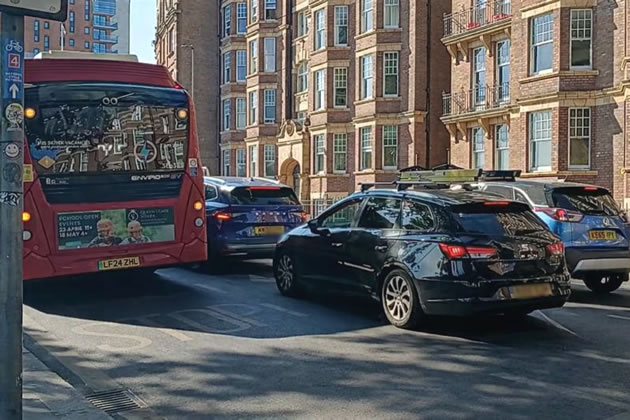
Lower Richmond Road has been particularly affected by increased congestion
July 10, 2026
The new Conservative-led administration on the council has launched a fresh package of proposed measures aimed at easing severe congestion across Putney, following months of complaints from residents, businesses and community groups about gridlocked roads and deteriorating bus journey times.
The new administration says it is acting after recognising “the significant frustration experienced by many residents and businesses due to increased congestion on local through-roads and residential streets.” Detailed technical reviews of traffic conditions on Putney High Street, Putney Bridge Road and Lower Richmond Road have informed the proposals, which the council describes as targeted interventions designed to address the root causes of congestion while maintaining safety.
The council says that cost and current design and safety standards mean that it is not possible to revert to the previous layouts so tweaking the redesign has to be the way forward.
After extensive traffic analysis, meetings with Transport for London (TfL) and walk-arounds with residents, the council has identified several changes it believes will have the greatest impact. An investigation is to being into the possible relocation of the pedestrian crossing on Putney Bridge and submitting a revised traffic signal layout to maximise green time for vehicles. In addition the bus lane operational hours on Putney Bridge Road will revert to those applied previously and cycle wands are to be removed. Elsewhere, there will be new CCTV installed to enforce existing ‘Access only’ restrictions on Putney Embankment and the council says it will explore ways to prevent rat-running and queue-jumping on roads around Lower Richmond Road.
Additional improvements already planned include removing the traffic island outside Snappy Snaps, reinstating two exit lanes from Putney Bridge Road onto Putney High Street, new lane markings near Putney Station, and widening the road outside TK Maxx.
Councillor Daniel Hamilton, Cabinet Member for Transport, said he had promised from “my very first day in this job” to listen to residents and businesses. “They’re rightly incredibly frustrated at the traffic congestion here in Putney and repeatedly tell us that some streets have been turned into a car park at certain times of day. It’s time to tackle the gridlock.”
Cllr Hamilton said congestion had been worsened by changes to signal timings, a new pedestrian crossing on Putney Bridge, the ongoing closure of Hammersmith and Albert Bridges, restrictions in neighbouring boroughs and rising traffic demand. “Our priority is to get Wandsworth moving again and reduce rat-running through residential streets,” he added.
Putney’s traffic problems escalated following the council-commissioned redesign of the Putney Bridge junction in 2024. Weighted average bus journey times on Lower Richmond Road eastbound during the morning peak quadrupled, rising from roughly seven minutes per kilometre to nearly 27.
On Putney High Street northbound, evening peak journey times climbed to around 17 minutes per kilometre by mid-2025. Although congestion had already been rising since 2022, the scheme intensified delays for thousands of commuters.
The redesign—intended to improve safety for cyclists and pedestrians—reduced the approach from Lower Richmond Road to a single lane. With Hammersmith Bridge still closed, Putney Bridge was carrying far more cross-river traffic than TfL’s modelling had anticipated. The result was a bottleneck that forced buses into long queues behind general traffic, with no priority mechanism to extract them. A council report in November 2024 admitted the changes had caused “unexpected congestion” and that the authority was “extremely concerned.”
The impact rippled across the wider bus network. Route 22, one of London’s busiest orbital routes, saw journey times on some days increase nearly fourfold. Routes 33, 72, N22 and N72—already diverted via Putney Bridge due to the closure of Hammersmith Bridge—were further compromised.
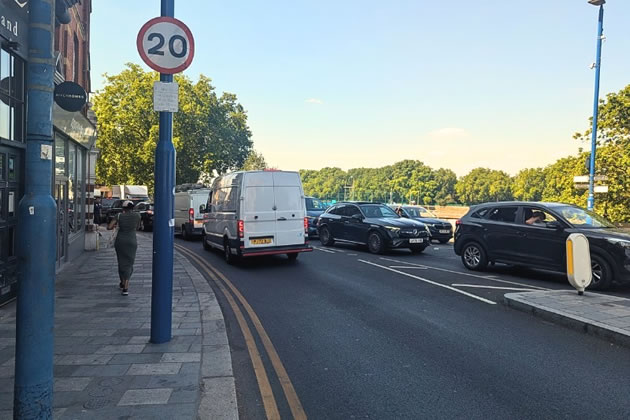
More recent data shows situation has improved but remains problematic. Picture: Wandsworth Council
Recent data shows journey times have begun to fall from their extreme peaks. On Lower Richmond Road, the worst delays of 25–27 min/km have eased to around 10–15 min/km, though still well above the historic baseline. Improvements have continued despite the closure of Albert Bridge, which might have been expected to add pressure.
A rolling programme of remedial measures since late 2024—reopening bus lanes, extending operating hours, adjusting signal timings, installing double yellow lines and realigning kerbs—has helped stabilise conditions. But journey times on both corridors remain materially above pre-scheme levels, and several works are still incomplete.
However, continued progress cannot be taken for granted with the Putney Society warning that the construction of a Premier Inn hotel and offices on the corner of the High Street and Putney Bridge Road (the former Brazilian restaurant site) may herald increased congestion. The developer estimates up to 60 deliveries a week for food, laundry and other supplies, plus numerous Uber pick-ups from the 200-plus room hotel. The Society estimates that around a third of vehicles, those eight metres or longer, will need to park on Putney Bridge Road, where there are parking restrictions, a bus lane, and near-permanent congestion for much of the day. The Putney Society raised concern about this development's transport impact with the Council in 2017 and repeatedly since.
The council says it will continue working with residents, businesses and community groups to refine the proposals. Any changes to the highway network must be agreed with TfL, which manages key parts of the infrastructure.
Like Reading Articles Like This? Help Us Produce More This site remains committed to providing local community news and public interest journalism. Articles such as the one above are integral to what we do. We aim to feature as much as possible on local societies, charities based in the area, fundraising efforts by residents, community-based initiatives and even helping people find missing pets. We've always done that and won't be changing, in fact we'd like to do more. However, the readership that these stories generates is often below that needed to cover the cost of producing them. Our financial resources are limited and the local media environment is intensely competitive so there is a constraint on what we can do. We are therefore asking our readers to consider offering financial support to these efforts. Any money given will help support community and public interest news and the expansion of our coverage in this area. A suggested monthly payment is £8 but we would be grateful for any amount for instance if you think this site offers the equivalent value of a subscription to a daily printed newspaper you may wish to consider £20 per month. If neither of these amounts is suitable for you then contact info@neighbournet.com and we can set up an alternative. All payments are made through a secure web site. One-off donations are also appreciated. Choose The Amount You Wish To Contribute. If you do support us in this way we'd be interested to hear what kind of articles you would like to see more of on the site – send your suggestions to the editor. For businesses we offer the chance to be a corporate sponsor of community content on the site. For £30 plus VAT per month you will be the designated sponsor of at least one article a month with your logo appearing if supplied. If there is a specific community group or initiative you'd like to support we can make sure your sponsorship is featured on related content for a one off payment of £50 plus VAT. All payments are made through a secure web site. |