Is the Boat Race Over Before it Leaves Putney?
Hugh Thompson says the leader at Festing Road always wins
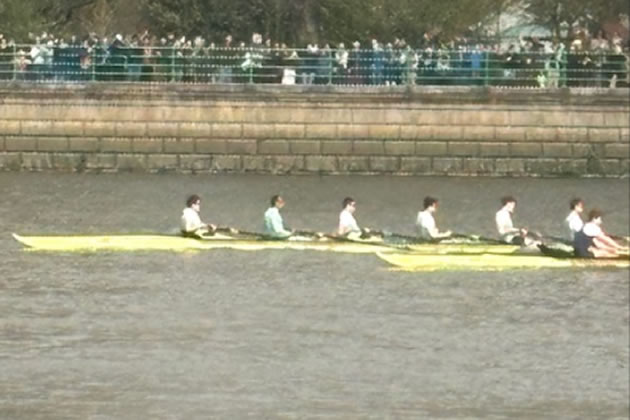
Cambridge men establish an early lead at this year's Boat Race. Picture: Hugh Thompson
April 9, 2026
For most spectators, the University Boat Race is a twenty-minute contest played out over 4.2 miles of the Thames. But for those watching from Putney — where the race begins — the drama can feel strangely compressed. The crews thunder past the towpath at speed, the crowd roars, and within moments the boats have swept out of sight towards Hammersmith.
For long-time Putney resident Hugh Thompson, who has watched the race from the end of Festing Road for two decades, that fleeting glimpse has come to feel like the whole story. Standing roughly 400 yards from the start, he says the pattern is so consistent it borders on predictable.
“Who is winning at the bottom of Festing Road always wins the race,” he says. “When have you ever seen anyone overtaking? Never. Once they get in front, even by a nose, they stay in front. I love the race and what it means to Putney, but it’s more a procession than an out-and-out contest.”
Hugh points to photographs he took at this year’s races, showing the leading Cambridge men’s crew already edging ahead as they pass the crowds lining the towpath. For him, this was another confirmation of what years of watching have suggested: by the time the boats reach his vantage point, the decisive move has already been made.
There is some logic behind his observation although it is not strictly true to say ‘never’. The Championship Course is famously asymmetric, with long sweeping bends that favour one station or the other. The opening stretch from Putney to the first major turn is short, and the crew that secures an early advantage often gains the inside line on the Surrey bend — a position that can be difficult to overturn.
Race analysts frequently note that overtakes on the Tideway are rare, and that the crew leading after the first bend wins more often than not. But that is not the same as saying the race is effectively decided at 400 yards. The early stages are turbulent, and the margin between the crews is often measured in feet rather than boat lengths.
Historical coverage shows that while early leads are influential, they are not absolute. There have been notable comeback victories, including Oxford’s dramatic one-foot win in 2003 and Cambridge’s recovery from a poor start in 2010. In the women’s race, Oxford famously came from behind in 2016 after a disastrous opening.
These examples are exceptions rather than the rule, but they demonstrate that the race is not mathematically settled in Putney, even if it sometimes feels that way to those watching from the start.
For spectators like Hugh, the issue is less about statistics and more about experience. The crowds at Putney Bridge and along the towpath gather for the atmosphere, the tradition and the sense of occasion — but the sporting contest itself is largely out of view within minutes.
“Hundreds of thousands watch from the towpath and millions on television,” he says. “But for us in Putney, it’s all over far too quickly.”
For those watching from Hammersmith or Chiswick, the race can look very different. The long mid-course bends, the changing stream, and the occasional clash of blades all contribute to a sense of ebb and flow. But at Putney, the race is a burst of noise and colour that disappears almost as soon as it arrives.
Like Reading Articles Like This? Help Us Produce More This site remains committed to providing local community news and public interest journalism. Articles such as the one above are integral to what we do. We aim to feature as much as possible on local societies, charities based in the area, fundraising efforts by residents, community-based initiatives and even helping people find missing pets. We've always done that and won't be changing, in fact we'd like to do more. However, the readership that these stories generates is often below that needed to cover the cost of producing them. Our financial resources are limited and the local media environment is intensely competitive so there is a constraint on what we can do. We are therefore asking our readers to consider offering financial support to these efforts. Any money given will help support community and public interest news and the expansion of our coverage in this area. A suggested monthly payment is £8 but we would be grateful for any amount for instance if you think this site offers the equivalent value of a subscription to a daily printed newspaper you may wish to consider £20 per month. If neither of these amounts is suitable for you then contact info@neighbournet.com and we can set up an alternative. All payments are made through a secure web site. One-off donations are also appreciated. Choose The Amount You Wish To Contribute. If you do support us in this way we'd be interested to hear what kind of articles you would like to see more of on the site – send your suggestions to the editor. For businesses we offer the chance to be a corporate sponsor of community content on the site. For £30 plus VAT per month you will be the designated sponsor of at least one article a month with your logo appearing if supplied. If there is a specific community group or initiative you'd like to support we can make sure your sponsorship is featured on related content for a one off payment of £50 plus VAT. All payments are made through a secure web site. |
Related links
|